Cameras are already common in warehouses, yards and industrial facilities. What is less common is turning that video into operational insight teams can use in time to respond. Manual review does not scale. Spot checks miss patterns. Incidents are often discovered after throughput, safety or customer commitments have already been affected.
Computer vision closes that gap when it is framed correctly: not as a futuristic control room, but as a practical layer that detects relevant activity and surfaces useful signals for supervisors and operations leads.
Why visibility still breaks down on the floor
Operational visibility fails for ordinary reasons. Coverage may exist, but attention is fragmented. Supervisors cannot watch every aisle. Radio updates arrive late. Paper checklists capture intent more than reality. By the time a bottleneck or unsafe pattern is confirmed, the shift has already paid the cost.
Teams need earlier awareness of:
- Movement of people and assets in key zones
- Operational events that affect flow
- Conditions that require oversight or escalation
- Context that helps decide what to do next
Computer vision is one way to convert continuous activity into timely signals — especially when camera environments already exist. The point is not endless recording. It is selective awareness that fits how a site already manages work.
Practical computer vision use cases
In warehouse and logistics settings, useful applications tend to focus on activity that matters for operations rather than novelty detection.
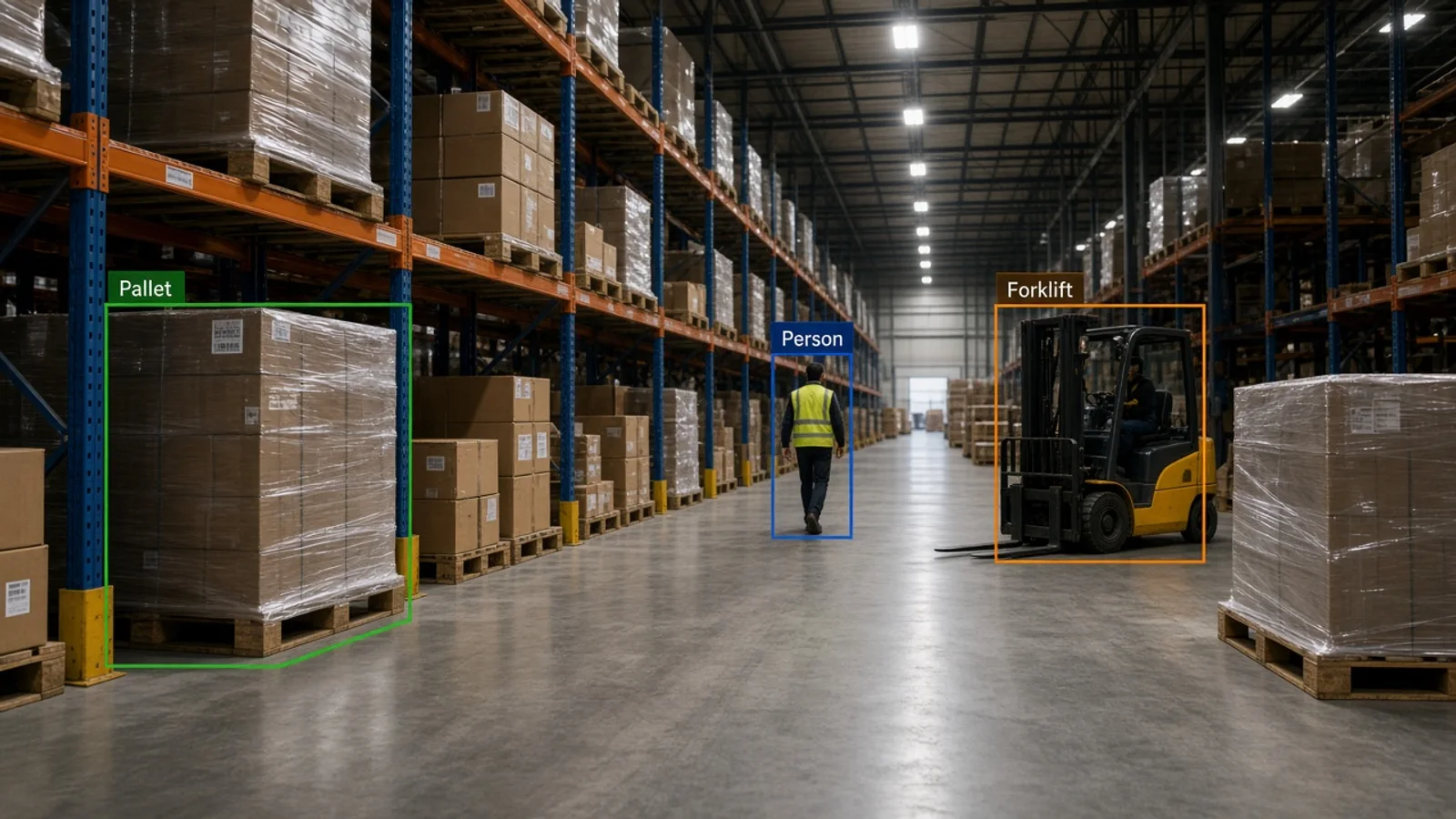
Activity monitoring. Detecting people, forklifts, pallets and other operational objects in view helps supervisors understand what is happening without standing in every aisle.
Warehouse visibility. Dock, aisle and staging areas can be monitored for congestion or unusual idle time so teams can intervene earlier.
Operational events. Loading, unloading and zone transitions can become structured signals instead of anecdotal radio traffic.
Safety and oversight. Vision can support awareness of conditions that deserve attention — always with human judgement for response, not automatic assumptions about intent.
Logistics environments. Yards and transfer points benefit from clearer awareness of movement patterns that affect scheduling and handoffs.
The common thread is actionable insight: fewer surprises, clearer context and faster operational response. A dock supervisor who learns earlier that a bay is blocked can reassign labour before trucks queue. A logistics lead who sees prolonged idle time in a transfer lane can investigate before the schedule slips further. Those are ordinary operational decisions made with better timing.
From detection to decisions
Detection alone is not enough. Operations teams are already busy; more noise is not progress. A practical vision system should:
- Prioritise events that matter for the site’s goals
- Reduce false fuss where possible through careful configuration
- Connect signals into workflows supervisors already manage
- Leave room for human confirmation on sensitive actions
Digitalsofts positions AISAP-CV around this model — computer vision that turns cameras and site activity into operational insight teams can act on. The emphasis is detection of people, assets and key activity; useful oversight; and integration with real industrial and warehouse settings rather than vanity dashboards.
Exact recognition performance varies by site conditions, camera placement and configuration. Claims should be validated in the environment where the system will run — not assumed from a brochure. Lighting, occlusions, camera angle and traffic density all change what is reliable. Treat site validation as part of the project, not an afterthought.
Designing for real industrial settings
Successful deployments start with operational questions, not technology shopping lists:
- Which areas create the most blind spots today?
- Which events would change a supervisor’s next action if seen earlier?
- What existing cameras or coverage gaps shape the design?
- How should alerts enter current shift routines?
From there, teams can assess coverage, configure detection for the activity that matters, monitor signal quality and refine thresholds based on lived operations. Vision works best as part of an operating rhythm — assess, deploy, monitor, act — not as a one-time install.
Alert design deserves equal attention. If every minor movement generates a notification, supervisors will mute the system. Prefer fewer, higher-value events. Route them into tools people already open during a shift. Include enough context — zone, time, related activity — that the next action is obvious without a long replay session every time.
People, privacy and operating discipline
Computer vision in workplaces raises legitimate questions about privacy, trust and how footage is used. Address those early. Be clear about which zones are monitored for operational purposes, who can review alerts, how long evidence is retained and what is out of scope. When staff understand that the goal is flow and safety awareness — not surveillance theatre — adoption is more durable.
Operating discipline also matters after go-live. Assign ownership for threshold reviews. Capture false positives and adjust. Train supervisors on when to escalate versus when to observe. Without that rhythm, even a well-configured system drifts into ignored noise or unused recordings.
Integrating vision with existing operations tools
Vision delivers more when it is not an island. Where possible, connect signals to warehouse management, incident logs or shift handover notes so the event becomes part of the same operational record supervisors already trust. That connection does not need to be elaborate on day one. Even a disciplined process for acknowledging alerts and documenting response improves continuity between shifts.
Start narrow: one high-value zone, a short list of events and a clear owner. Expand coverage only after the site proves it can absorb and act on the signals. Scale without that discipline multiplies noise faster than insight.
A business takeaway
Computer vision improves operational visibility when it answers concrete questions about activity, flow and oversight. It is not a substitute for good site management. It is a way to extend awareness across spaces people cannot continuously observe.
If your facilities already have cameras but still rely on delayed manual reporting, the opportunity is to convert passive recording into timely operational signals. Start with one high-value zone, define the events that matter and measure whether supervisors respond earlier with better context.
Digitalsofts can help operations teams evaluate AISAP-CV style approaches against real site conditions — focusing on visibility and response, not speculative performance claims.